Cold temperatures and snow are no reason to let your smoker hibernate for the winter, but barbecuing in frigid conditions poses unique temperature control challenges. From lighting the coals to tracking temperatures from the warmth of the indoors, we have all the thermal tips and tools you'll need. Shovel a path to your smoker and become ready for some winter BBQ!
Peak Cold Weather Smoking Tips:
The elements you're up against are cold temperatures, air current, and precipitation. Nosotros've compiled a list of the best skillful recommendations to manage your winter charcoal-broil projects.
Plan Alee. It's going to take longer than normal to calorie-free the coals, heat your smoker, and cook the meat. Program on the unabridged procedure taking about 30% more than time.
Clear a path free of snow and ice. Slippery atmospheric condition are dangerous around a grill or smoker, especially when carrying trays of food or large cuts of (hot!) meat.
Bundle upwards, but be sure you lot don't accept any loose articles of clothing that could grab on burn.
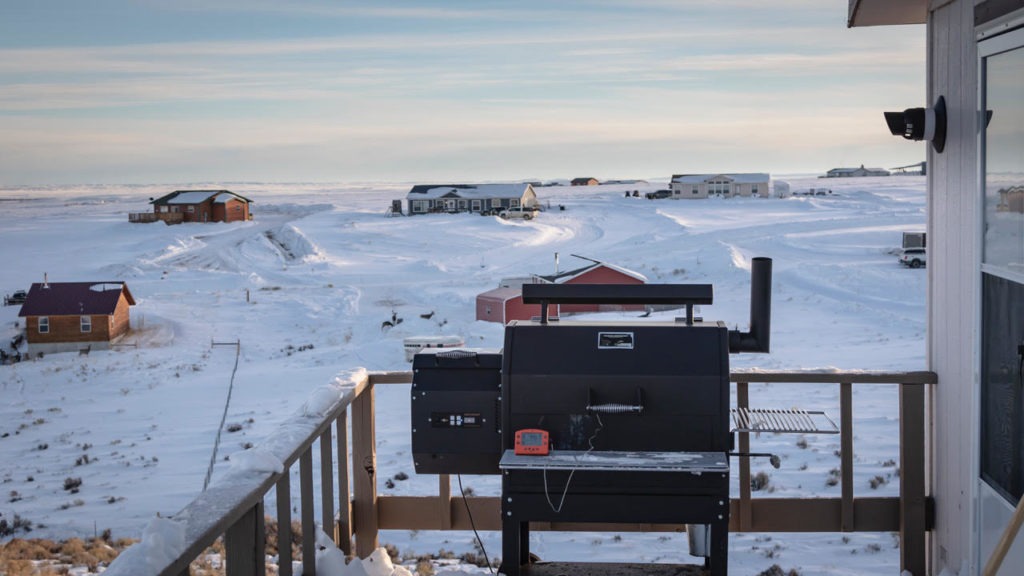
Shield your smoker from the elements:You lot'll desire to keep your smoker out of falling snowfall and pelting every bit much as possible, and abroad from air current. Never place your smoker in a garage or on a covered porch. Information technology needs to exist at to the lowest degree 5 feet away from any buildings or combustible materials.
Air current and precipitationalong with cold temperatures tin actually cool the ambience temp in a thin metal cooker. Ceramic cookers have a higher heat retention chapters and will maintain cooking temperatures more than steadily than meat smokers. Wind can blow out the flame in a gas cooker.
Better Estrus Retention
Bricks: In a metal cooker, you can identify bricks within to assistance retain oestrus and maintain the cooker's temperature.
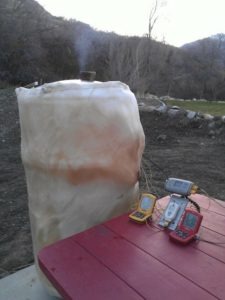
Insulate: To help a metal smoker maintain its temperature and salvage on fuel usage, insulate it. There are products available for covering smokers during the winter to retain estrus. Some avid smokers use hot h2o jackets or welders' blankets for insulation. Be sure to wrap your smoker with flame retardant material.
Treat your cooker like you treat yourself when information technology's common cold. Go on it dry out, proceed it out of the wind, insulate, and accept in more calories (fuel and oxygen). —John Dawson, PatioDaddioBBQ.com
Bring meat to room temp. Reduce smoking time by starting meat at lxx degrees rather than 40 degrees.
—Smoking in Cold Conditions, GirlsCanGrill.com
Keep the Lid Closed: Heat is lost very speedily any time the lid is opened—specially with a metal smoker—and the cooking temperature can take quite some time to recover. Opening the lid unnecessarily will prolong the length of your melt and apply more fuel. Ceramic smokers will recover the temperature faster because of their heat-retention backdrop, simply even with these cookers, it is best to only open the lid when absolutely necessary.
Use elementary recipes that don't require multiple lid-opens. You don't want to be opening the chapeau to flip or spritz the meat repeatedly. We chose baby dorsum ribs for our cold weather smoking projection because information technology's at the quick terminate of the BBQ cooking-fourth dimension spectrum. Some people will smoke a brisket or pork shoulder for about six-8 hours and finish cooking in the oven.
Close the Lid! "If you're looking, you're not cooking." —Richard Wachtel, GrillingWithRich.com
Temperature Tracking: The need to balance ventilation adjustment for wintertime conditions and keeping the hat closed at all costs brand tracking temperatures accurately absolutely critical.
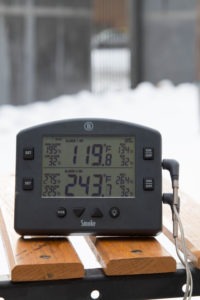
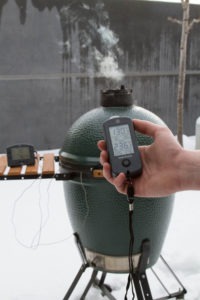
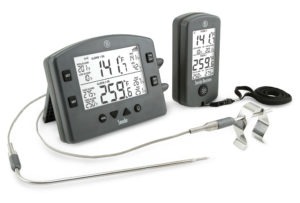
Smoke™ For The Win! A dual-channel, leave-in probe thermometer like Smoke is the ideal tool for the job. You can monitor both the pit and meat temperatures at the aforementioned time on one device, and its wireless receiver is priceless during the wintertime so you can proceed an eye on your temperatures from the warmth of the indoors. You'll merely go exterior to add more fuel to the smoker or to verify the meat's pull temperature one time the loftier alert sounds.
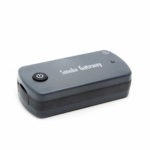
Gateway to the rescue.Not only tin you rely on the receiver to go along you out of the common cold, just you tin also trust the Smoke Gateway to monitor temperatures not only from the comfort of your fireside, just likewise from the shop, the role, or the ski gradient. The Wi-Fi Gateway sends your current temps to the cloud where you access them past means of our gratis app (available for Android or iOS).
Q: Can my thermometer handle winter conditions conditions? A: YES! The operating range of 32–122°F (0–50°C) as stated in the specs for Smoke, ChefAlarm®, and DOT® is important for long term storage and care of your products. But for the duration of a cook, your ThermoWorks warning thermometer tin can withstand rain, snowfall, and temperatures well below freezing (32°F [0°C]).
Melt to Temperature: Allow for 20–thirty% more than fourth dimension, only it'south about of import to guess your meat's doneness by its internal temperature, not by how long information technology has been in the smoker.
Cook to temp, not fourth dimension. Know that the melt will likely accept longer, and so utilise your tempreature probe in your favor and consider a wireless version to avert opening your smoker. —Mary, Vindulge.com
Go on the Finished Meat Hot:When your meat is done, be sure to bring it inside on a heated platter and cover with foil or a lid to protect it from the cold, wind, rain, and snow when transporting indoors. You tin can warm the platter in a low 200°F (93°C) oven.
Examination Run: Some experts recommend a dry run to figure out how to best manage your smoker's temperature before adding meat to the equation. This way you tin learn the tips and tricks that work best for your weather condition and cooker.
Every bit usual, there's no substitute for experience, so doing a dry run without food makes a lot of sense. Main your musical instrument! —Meathead, AmazingRibs.com
The Difference Between Infant Back and Spareribs
Babe back (or loin dorsum) ribs are non to be confused with St. Louis manner spareribs.
➤ Spare ribs are taken from the lesser of the ribs—on the side of the abdomen of the sus scrofa. This is why they are bigger, meatier, and a little tougher cut of meat.
➤ Infant back ribs are taken from the tiptop of the rib cage—close to the loin of the pig. This is why they are a smaller (shorter) and more than tender cut of meat.
Fatty and connective tissue of baby backs and spare ribs make them the perfect candidates for low and tiresome cooking. (See our mail, The Difference Between Grilling and Barbecue.)
BBQ Baby Back Ribs Recipe
Ingredients
2 racks baby back ribs (virtually ii to 2-one/2 lbs. [0.9–1.1 kg.] each)
Apple juice for spritzing (you'll only exist spritzing when the ribs are first placed on the smoker, no opening the lid to spritz during the cook)
Yellow mustard for slather
Diva Q'south Kansas City Rub
1/2 cup brown sugar
1/4 loving cup granulated saccharide
1/4 cup smoked sweet paprika
ane tbsp medium-grind blackness pepper
1 tbsp kosher salt
i tbsp chili powder
1 tbsp garlic powder
one tbsp onion powder
i tsp cayenne
Sauce/Coat
1 lb butter (.v kg) (or use squeezable Parkay margarine)
Brown sugar
Honey
Tiger sauce
Other Equipment
Smoker setup
Apple or cerise wood chips or chunks
Smoke alarm thermometer
Thermapen® Mk4
Instructions
Notation on Cook Time: Our cook took near ix hours from the moment nosotros lit the coals until the ribs were sliced and ready to eat. Definitely longer than it would have to cook ribs in the summer! Programme ahead to allow enough time for your total cook.
Burn upwardly the Smoker
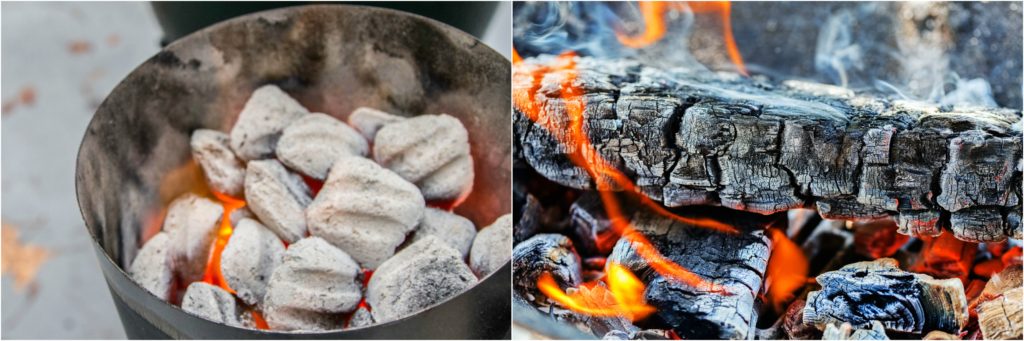
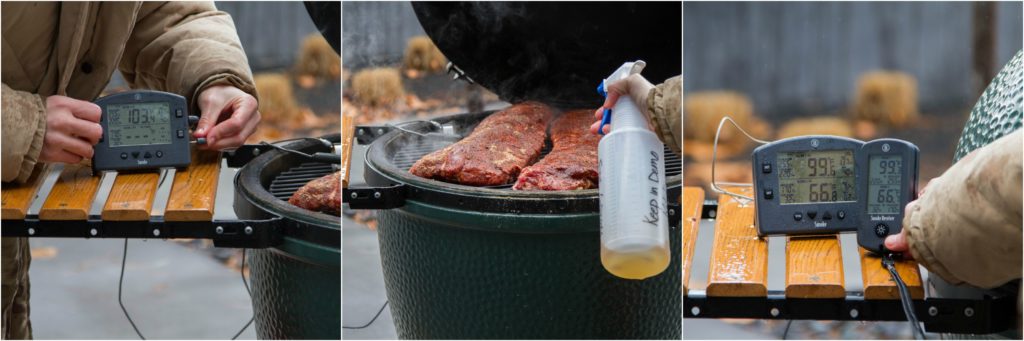
Add lit dress-down to your smoker using virtually fifty% more than coals than y'all normally would during warmer months.
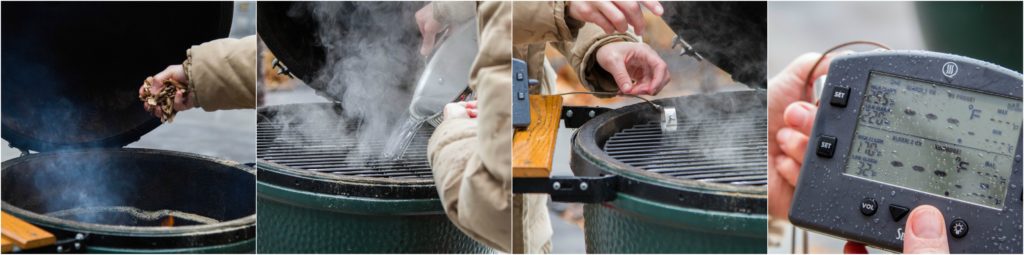
Add wood chips or chunks to the coals and shut the lid. It may take quite some fourth dimension for your smoker to come up to cooking temperature in cold weather (possibly ane to 1-1/2 hours)—program for a lengthy procedure.
If you're using a ceramic smoker like a Big Green Egg, it will have quite a fleck of time for the ceramic to absorb and retain plenty heat to maintain the temperature you lot're aiming for. But later on on, all the retained estrus will maintain a steady temperature for the elapsing of the cook.
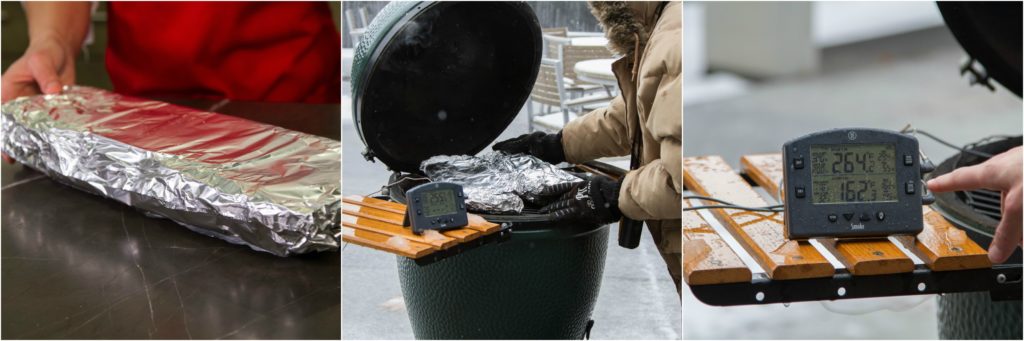
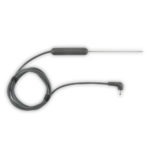
Secure a Pro-Series® Air Probe with a Grate Clip. Set Fume's cooker channel's low alarm to 220°F (104°C) and the high warning to 255°F (124°C). Keep an middle on your smoker'southward temperature with the wireless receiver or the Smoke Gateway while you prepare the ribs. No running out into the cold weather to cheque your temps!
Gear up Ribs
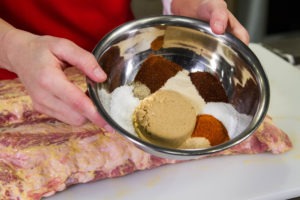
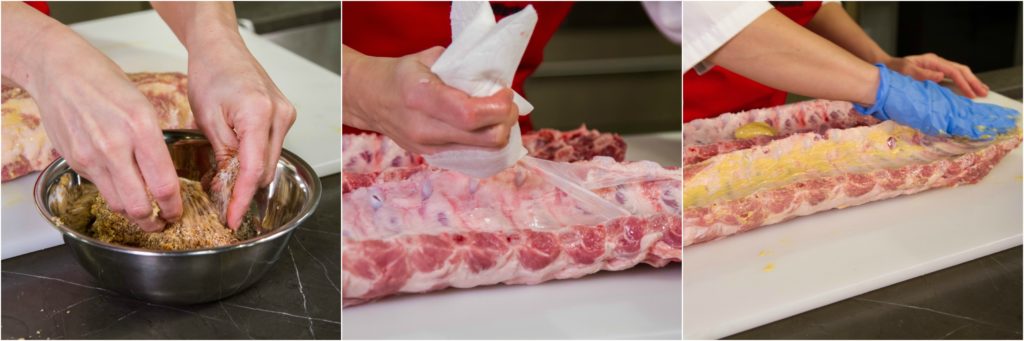
Mix together spice rub ingredients together evenly and set aside.
Trim any excess fat, and remove the membrane that covers the bone-side of the ribs, and pat dry with paper towels.
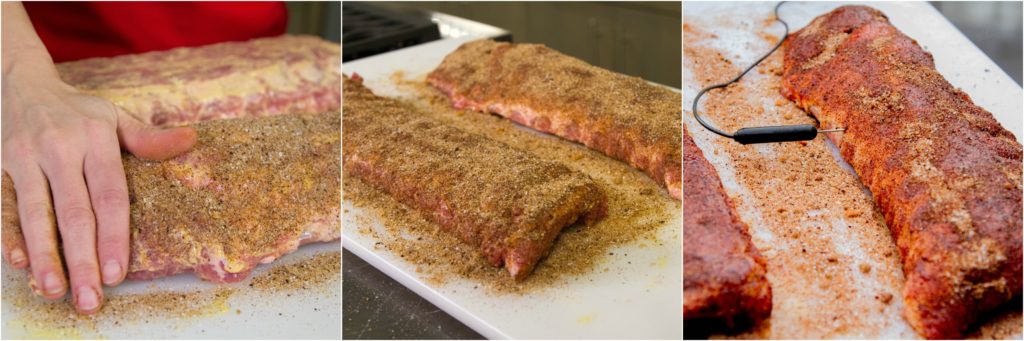
If desired, slather the ribs with mustard, then generously apply spice rub to all sides.
Using a Pro-Series Waterproof Needle Probe, identify the probe in the center of the rack between two basic in the eye of the compact surface area.
Cook Ribs
Place the ribs on your smoker's grill grate meat-side upwards and close the hat.
Adhere the needle probe to Smoke's other channel. Set up the high alarm for 170°F (77°C).
Maintain an fifty-fifty temperature past adjusting your cooker's lesser and elevation vents as necessary and add fuel as needed. Smoke'due south wireless receiver is priceless for smoking in cold weather! Stay warm while y'all track your temps.
This part of the cook may take effectually four hours.
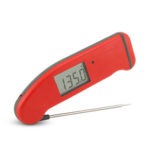
When the meat'southward loftier alarm sounds, verify the internal temperature with an instant-read thermometer similar a Thermapen. If a lower temperature is plant in your rack of ribs, replace the needle probe so it's tracking the lowest temperature, close your smoker'due south lid and cook until the high alarm sounds.
Once the internal temperature is verified, remove the rack of ribs from the smoker and disconnect from Smoke. Take the ribs inside for the next step.
Wrap the Ribs and Return to the Smoker
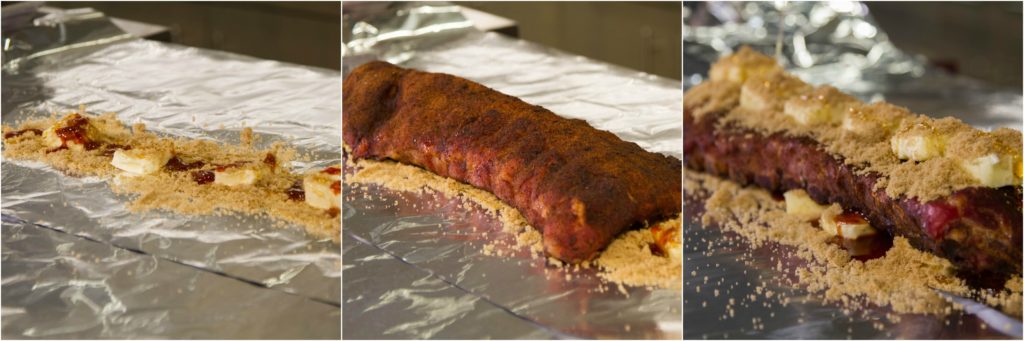
Arrange 2 layers of heavy duty foil large enough to wrap the rack of ribs. Slather 4 ounces (1 stick [113 grams]) of butter on the foil, sprinkle down some brown sugar, drizzle beloved and tiger sauce.
Lay the ribs downward on the sauce ingredients meat-side down, and repeat the same ingredient application on the summit of the ribs. Wrap ribs securely.
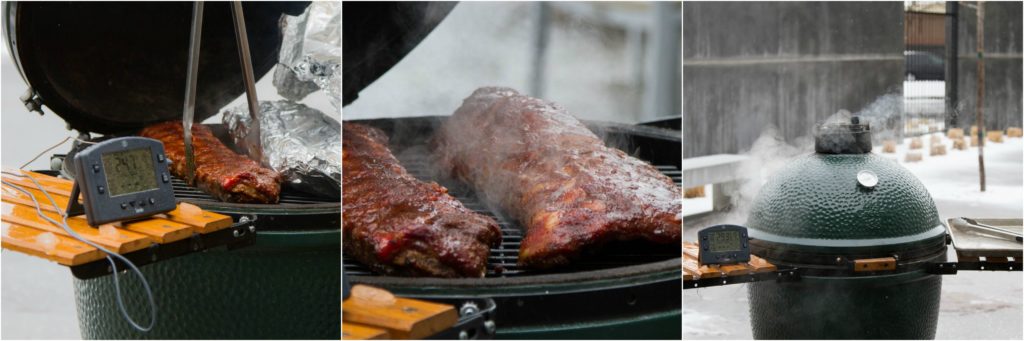
Return wrapped ribs to the smoker and cook for 1 hr meat-side downwardly.
Unwrap the Ribs and Return to the Smoker
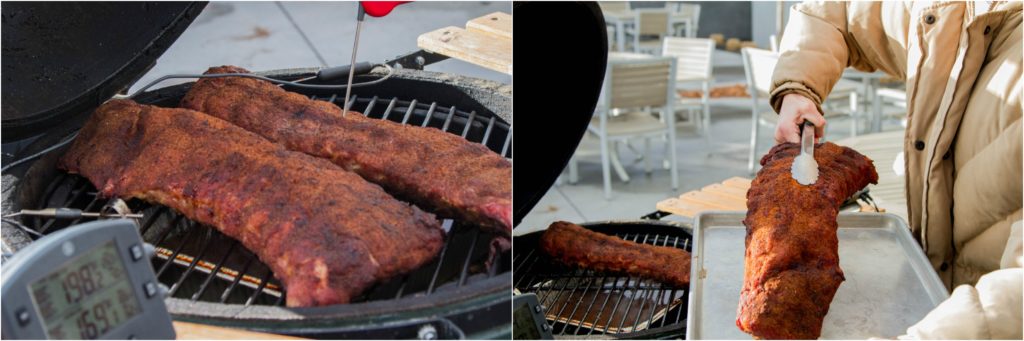
Pull ribs from the smoker, unwrap and return to the smoker (meat-side upward) to "set up" the coat that has adult on the ribs while they were wrapped.
Supervene upon the needle probe and fix Smoke'southward high alarm to 190°F (88°C). Cook until the ribs' internal temperature reaches 190–195°F (88–91°C). Be sure to verify the doneness temperature with a Thermapen.
This portion of the melt may accept one-2 hours.
Rest and Serve
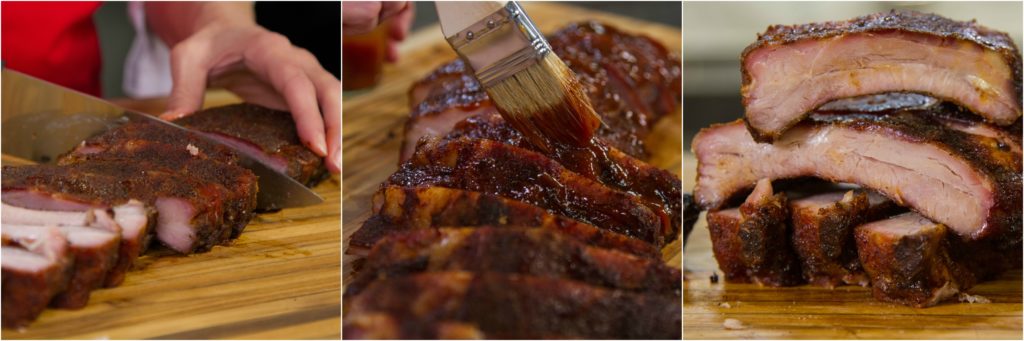
Pull from the smoker and rest for ten-15 minutes.
Brush the whole racks with your favorite barbecue sauce, or leave them every bit-is.
Cut the rack by slicing between each rib bone.
Be sure you have plenty of napkins nearby and enjoy!
With expert communication and the right temperature tools, BBQ season doesn't have to exist confined to the months between Memorial 24-hour interval and Labor 24-hour interval. If y'all're an all-weather pitmaster, or just peckish a taste of summertime to chase away winter blues, plan ahead and rail your temperatures for a successful cold-weather charcoal-broil.
Products Used:
Smoke
Pro-Serial Needle Probe
Thermapen
Smoke Gateway Wi-Fi Span
Resources:
Baby Back Ribs Recipe, Malcolm Reed of How to BBQ Correct
Diva Q's Charcoal-broil, by Danielle Bennett
Cold Weather Grilling and Smoking, Meathead of AmazingRibs.com
Thanks to our affiliates for their input and expert advice!


0 Response to "Which Is More Expensive Baby Back Ribs or Spare Ribs"
Post a Comment